Conferences
Oral History Netzwerktreffen
Artisanal labour in Accra, Ghana and Lagos, Nigeria – first experiences with oral history interviews
This presentation addressed conceptual and practical reflections and experiences with oral history in the context of the project.
Firstly, it reflected on the relationship between the different methods of the project. The presentation addressed the interplay between conceptual aims and the realities of conducting fieldwork.
Secondly, the presentation offered a first reflection on ‘approaching the field’: It addressd the position of the researcher in the socio-economic context of Lagos and Accra, and reflected on the position of the researcher in the context of multiple and complex cultural and national ‘belongings’ – a so-called “halfie”-position by virtue of migration, overseas education or parentage.
Thirdly, and based on preliminary insights, this paper reflected on possibilities and constraints of writing a history of “making things”.
Lagos Studies Association Conference 2023
Navigating and negotiating schools and regimes of artisanal production: Goldsmiths in Lagos, ca. 1920-1980
This presentation offered a snapshot of ongoing research on artisans and craftspeople, and in particular goldsmiths. It sought to give an overview of the history of goldsmithing in Lagos, and then turned to the ways in which craftspeople were ‘educated’ more generally. The paper addressed how practicioners envisioned and called for new aesthetic positions, not least against the backdrop of the ways misssionaries and colonial administrators had envisioned the practising of arts and crafts. Moreover, this presentation turned to the introduction of tests for goldsmiths in 1944, and highlighted how goldsmiths contested and challenged colonial notions of what constituted ‘valuable’ knowledge for practising the profession.
European Conference on African Studies 2023
Projecting material futures – craftspeople and entrepreneurs in colonial Nigeria
This paper focused on visionary practices of people engaging in the production of goods or the provision of services. That is to say, it turned to the ways in which ‘entrepreneurs’ navigated the colonial economy, to their prospections of how to secure survival and realise their economic aspirations. In particular, the paper highlighted how the African Home and Foreign Industries Bakery as well as I.B. Thomas and his Akede Eko printing works sought to secure loans from the Colonial Development Board to expand their businesses in the 1940s. It showed how the two applicants were encountering unknowable decision-making processes and in order to anticipate these, were gathering information, as well as seeking to shape presentations of their economic ambitions in a way that was legible to colonial projections for economic futures.
Deutscher Historikertag (German Historians' Conference) Leipzig - "Afroglobal Futures", September 2023
Panel title: Afroglobal Futures Paper title: Global history of Information Infrastructures in Lagos
This presentation addressed the global inequality in information flows with regards to news media to contribute to a discussion of the possibilities and limitations of an Afro-global history of the present. In contrast to a focus on integration and convergence in global history, which often re-centers the Global North, this presentation sought to point to the dynamic ways in which newspapers in Lagos at times sought connection, and at times deliberately disconnected from global/imperial news networks.
The paper zooms in on the history of the Reuters news agency, which had been a key information broker in the "British World" and beyond for a long time since the nineteenth century. While Reuters charged high sums for supplying the so-called Dominions (such as Australia and New Zealand) for supplying them with news, Reuters was available at virtually no cost in Lagos, as it was distributed via the colonial administration. But it seems that only some Lagos newspapers, and even then, only at specific times, were interested in Reuters news. The paper seeks to understand reasons for such a dynamic way of engaging with global information flows.
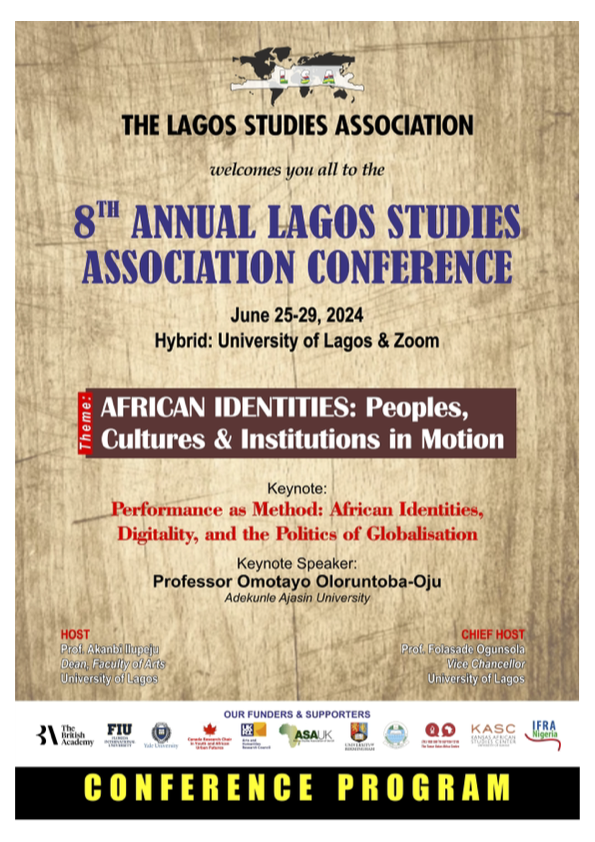
Lagos Studies Association Conference, 2024
"Women goldsmiths in Lagos, ca. 1960-1990: Networks of Trust and Changes in Craft Production"
This presentation focused on women goldsmiths in Lagos, ca. 1960-1990, and illustrated how they were entering this profession. Furthermore, this paper sought to show how the profession was changing in the 1980s in the context of economic crisis and increasing concerns about security. It highlighted how women managed such challenges and how they initiated and contributed to changes which made it possible to continue this profession despite challenges.
While goldsmithing might be considered a profession which is dominated by men, interviews in Lagos show that women were becoming more and more visible as goldsmiths from the 1960s. The literature for Ghana suggests that it was higher education that facilitated women joining the profession. This was not available in Nigeria, but women nevertheless joined the profession suggesting a more complex explanation. With the economic crisis, women devised various strategies to manage challenges. As this paper sought to highlight, women reconfigured their relationships with customers, creating ways to interact which were shaped by trust. Although some women left manufacturing behind, they could continue practising the profession in a modified form.
African Studies Association of the UK Conference, August 2024
Panel title: New African Economic Histories. Paper title: "Approaching a history of 'Making Things': women goldsmiths in Lagos, ca. 1940-1980. Creating, Meaning Making and Experience"
This presentation addressed the importance of artisanal labour and craft production for West African economies. Its aim was to point to knowledge about making and knowledge systems of making, and to think about ways in which we might think about the relationship between crafts in West Africa and global histories of capitalism.
The focus of the paper was on women goldsmiths in Lagos, and it situated their activities in the broader, historical context of "making things" in Lagos. That is to say, it addressed the various ways in which productive labour has been discussed in Lagos in news media and other printed materials. It then turned to the ways in which tools and machines, and thus "regimes of making", changed or remained seemingly unchanged: it argued that various ways of "making things" exist in parallel which comments on linear notions of progress and innovation, but also speaks to the workings of capitalism.
Seminar Series: Anthropologies of Skill and Making, 2024
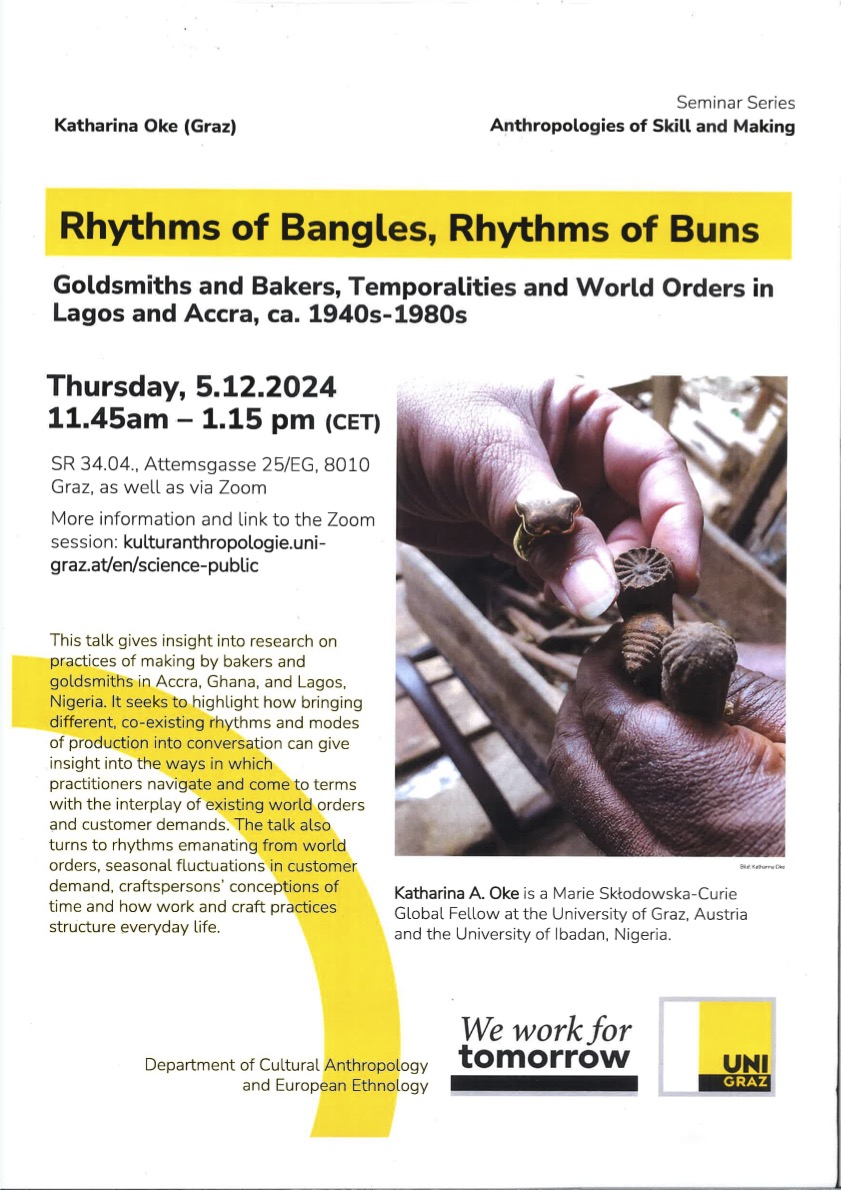
"Rhythms of Bangles, Rhythms of Buns: Goldsmiths and Bakers, Temporalities and World Orders in Lagos and Accra, ca. 1940s-1980s"
This talk has given insight into the work - the "making" - of bakers and goldsmiths in Accra and Lagos. It has focused on different rhythms that structure this work - such as those coming with changing tools and machinery. Of interest were however also how world orders, such as economic world orders or world orders reproduced in media, that portray a world in which Africa is marginalised, shape and inform processes of "making".
The talk sought to illustrate how makers bring different, co-existing rhythms and modes of production into conversation. And that this gives us insight into the ways in which practitioners navigate and come to terms with existing world orders and customer demands.
Re-search: A Workshop Exploring the Notion of Research as Theory, Practice, and Identity
"Research, Community, and Brokerage: Reflections from a 'halfie' position"
This paper has reflected on what "research" might mean. It has started thinking about this from a position in which culture or identity is mixed by virtue of migration, overseas education or parentage. What tensions and comforts come with such positions? What can research mean in terms of identity and community building? Who is the audience we imagine when doing research?
With this reflection, this paper seeks to contribute to broader thinking about how the ways we do research can reflect a wide range of experiences in the academy and beyond. It also seeks to encourage critical thinking about what is considered objective, neutral and worthy knowledge. It asks about the kinds of relationships we want to build when doing research.